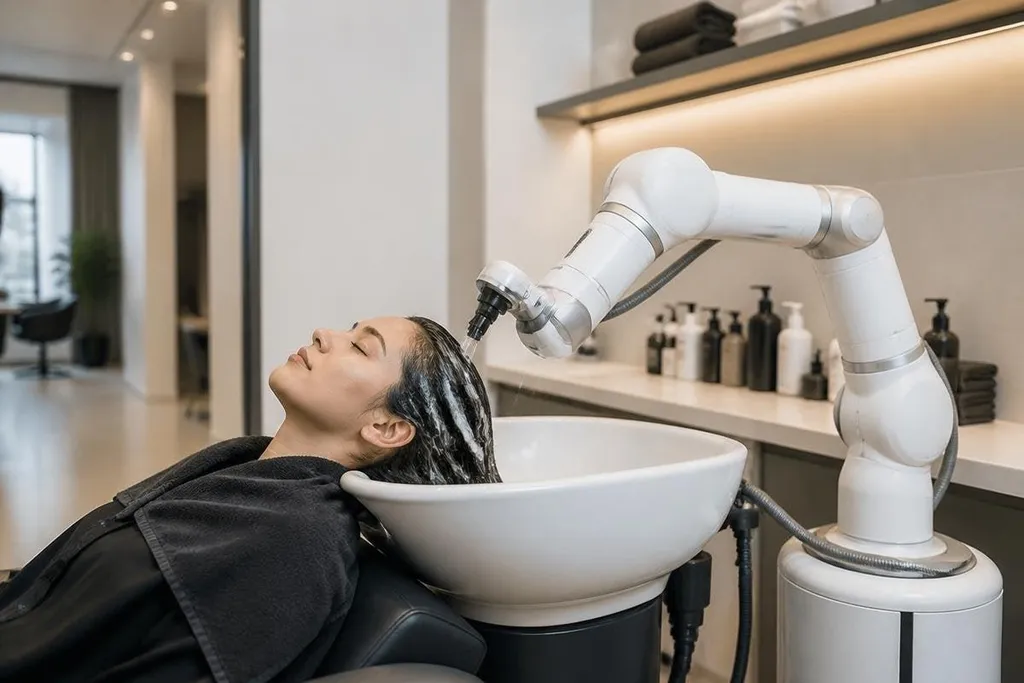
A salon robot would face hair, skin, water, heat, and people who move without warning. That makes the first useful systems far more likely to handle repeatable tasks than full haircuts or massages.
For owners, the question is practical: which jobs can automation do safely, and where does a person still need to make the call?
Quick read
- Robots could manage towel handling, stock checks, room cleaning, or tool sterilization.
- Cameras and force sensors could help a robot work near a client, but safety testing comes first.
- No price, salon trial, or named product is supplied here, so any business case remains unproven.
Where robots may fit first
The easiest jobs to automate have a fixed place, a repeatable motion, and a clear finish point. A robot could move clean towels between a shelf and treatment room, carry used items to a collection point, or check whether a product bottle needs replacing.
Those tasks sound small. They also take staff away from clients. A system that handles them would need a mobile base, a gripper suited to soft items, and a way to stop when a person enters its path.
Cleaning may offer another early use. A mobile robot could follow a mapped route through empty rooms, while a smaller arm could wipe a work surface or load tools into a sterilizer. The exact job would depend on the room layout and the cleaning equipment already in use.
Automation could also help with stock control. A camera can read labels and count items on a shelf, while software records what was taken during the day. That would give an owner a clearer stock list, but the system would still need a person to check damaged packaging, missing items, or products stored in the wrong place.
Client-facing work has a higher bar
Hair washing, nail care, skin treatment, and massage all involve contact with a person. The robot has to sense force, adjust its motion, and stop quickly when the client shifts position.
A camera alone can't tell the full story; a towel, strand of hair, or hand can block its view. A programmed arm may repeat the same path accurately on a test stand, but a real client changes posture, speaks, turns their head, and may react to pressure.
That gap matters more in a salon than in a factory because the object being handled can report discomfort. Staff also make choices that are hard to turn into fixed rules.
They can spot irritated skin, ask about pain, change water temperature, or stop a treatment when something looks wrong. A robot could follow instructions, but the supplied material gives no evidence that a salon system can make those judgments safely.
I’d start with back-room tasks and wait for public safety data before putting an arm near a client’s face.
The business case needs real numbers
The appeal is easy to describe: staff spend less time carrying, cleaning, and counting, while clients get more direct attention. The claim only matters if the robot’s purchase, service, training, and downtime cost less than the hours it replaces.
That calculation needs a live trial. An owner would need the robot’s operating hours, charging time, cleaning rate, failure rate, and the number of staff minutes saved per shift. Without those figures, “labor savings” is a label rather than a result.
A salon owner also needs a dated record of how the system handles faces, voices, storage, and consent. Robot24.com robotics coverage can help place those details beside the machine’s task before anyone treats a privacy plan as ready.
Privacy adds another question. Cameras used around treatment rooms could record faces, skin, or conversations. A salon would need clear rules for storage, access, deletion, and consent before installing such a system.
A buying check for salon owners
Use these questions before asking for a quote:
- Name the task: Write down the exact job, start point, finish point, and handoff.
- Count saved minutes: Measure staff time over several normal shifts before comparing it with robot time.
- Check the stop system: Ask how the robot detects a hand, person, spill, blocked route, or sensor fault.
- Ask for trial records: Request results from a real salon or spa, not only a staged demonstration.
- Price the full setup: Include installation, software, training, repairs, cleaning, and replacement parts.
A small pilot in a storage area may teach more than a polished client-facing demo. It can show where the robot needs help, how often it stops, and whether staff actually gain time.
The next useful proof will be a public salon trial with task time, safety events, service cost, and client feedback. Until those figures exist, robots belong in the repeatable work around the treatment, not in charge of the treatment itself.